It was an ordinary evening at a modern poultry farm just outside Vienna, Austria. Inside the climate-controlled sheds, tens of thousands of broiler chickens were feeding quietly. Ventilation and temperature-control systems worked steadily, maintaining stable temperature and humidity, just another routine evening in the flock’s six-to-eight-week growth cycle.
On the grid side, a brief voltage fluctuation occurred unnoticed.
For most people, such a fluctuation amounts to nothing more than a flicker of the lights. But at this poultry farm, a power interruption means ventilation stops and temperature control fails. Inside a sealed shed, air quality and temperature begin to change within minutes. If the outage continues, the flock faces the risk of oxygen deprivation and thermal shock, potentially causing large-scale mortality and direct losses running into millions of euros in a single incident.
For high-density livestock farming, electricity isn’t optional, it’s essential.
The Response Gap of Diesel Generators
The traditional backup is a diesel generator. But it takes seconds, sometimes tens of seconds, to start and reach full load. During that gap, ventilation and temperature-control systems shut down. When the generator finally supplies power, the equipment does not automatically restart. A worker must walk through the entire poultry house and manually restart every system, a process that takes around two hours. For the flock, those two hours without ventilation or temperature control can be catastrophic.
What the customer needed was not a “backup power source,” but a system that could take over the load the instant the grid fails.
What 20 Milliseconds Really Means
A human blink takes roughly 100 to 300 milliseconds and 20 milliseconds is less than one-fifth of that. In other words, before a person can even notice what has happened, the system has already completed the switch from grid supply to battery power. For the ventilation and temperature-control equipment in the shed, a 20-millisecond gap is far too brief to cause a shutdown or restart surge — motor speed remains virtually unchanged, and temperature does not change perceptibly.
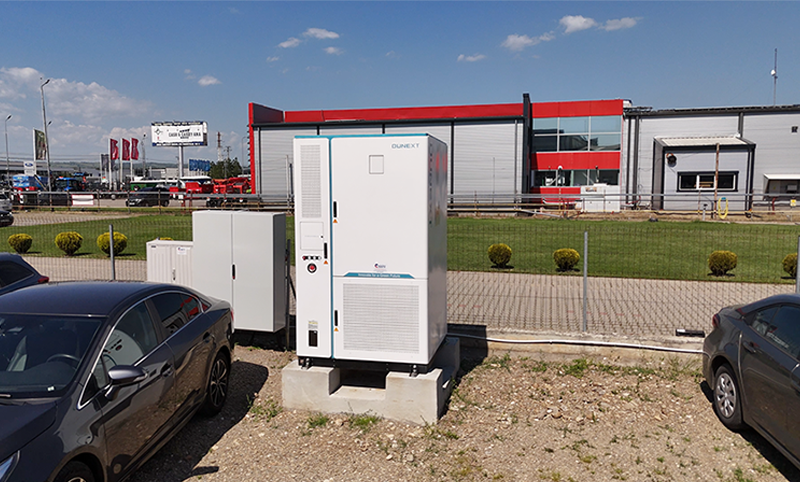
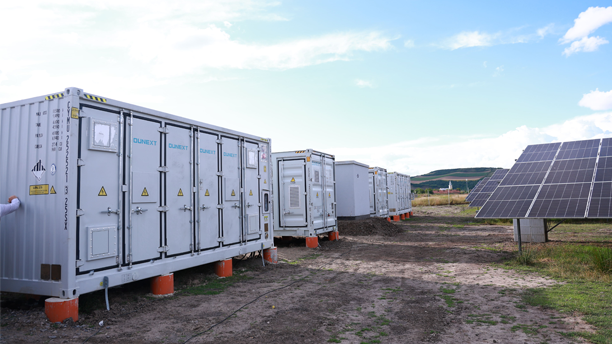
Dunext’s PowerHill solution for this farm was designed around exactly that target. Three PowerHill 105kW/233kWh liquid-cooling storage cabinets, with a total capacity of 699kWh, are integrated with a 360kWp PV array, a diesel generator, and the public grid, all coordinated by an intelligent EMS.
Under normal grid conditions, the system prioritizes solar power, storing surplus energy in the batteries. The moment the grid fails, the storage system switches seamlessly to off-grid mode within 20 milliseconds, taking over all critical loads. The diesel generator then starts and runs in parallel with the battery system. Throughout the entire process, the shed’s ventilation and temperature-control equipment never stops.
In the lab, Dunext simulated a demanding scenario using a 67kW high-power inductive motor, switching abruptly from grid-connected charging to off-grid operation. The measured transfer time was 19.8 milliseconds, with voltage fluctuation below 5% and no significant current surge. For the farm’s ventilation and temperature-control systems, those 20 milliseconds make all the difference.
Liquid Cooling: Built for Highly Inductive Loads
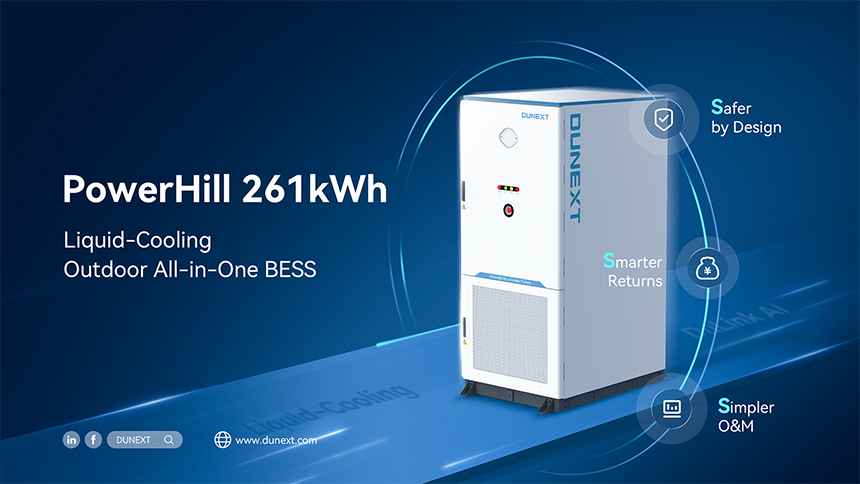
The farm’s core equipment, motor-driven ventilation and temperature control systems represent highly inductive loads with high inrush currents at startup, placing extreme demands on power response speed and stability. Dunext’s liquid-cooling PowerHill 233kWh use precision thermal management to keep batteries operating within their optimal temperature range, designed to handle the startup demands of inductive loads with millisecond-level response, while the compact all-in-one design reduces installation footprint on the farm.
Beyond Backup: A Revenue-Generating Asset
For the farming business, this PowerHill system is first and foremost a line of defense for power safety, dramatically reducing the risk of flock mortality due to outages and safeguarding production continuity. But its value goes further. Through peak-valley price arbitrage, diesel generator substitution, grid ancillary services, and improved PV self-consumption, the storage system generates ongoing financial returns while protecting production. The pre-installed electricity market interface prepares the farm for future participation in energy trading and additional revenue streams.
For the poultry farm, those 20 milliseconds are the difference between uninterrupted production and catastrophic loss. Beyond protection, the system turns a necessary safeguard into a revenue-generating asset.